Real-World Internship Experience
Inside Alpha Cohort: How Real-World Experience Shaped Our Summer Fellows
August 17, 2026

Real-World Internship Experience
August 17, 2026
For many college students, one of the hardest parts of preparing for a career is answering a deceptively simple question:
How do you gain experience when you have not yet been given the opportunity to get experience?
A classroom can teach theory. A resume can describe potential. But there is something different about sitting in a professional meeting, contributing to a real project, communicating with a supervisor, receiving feedback, and realizing that your ideas have value outside of a classroom.
That is where confidence begins to change.
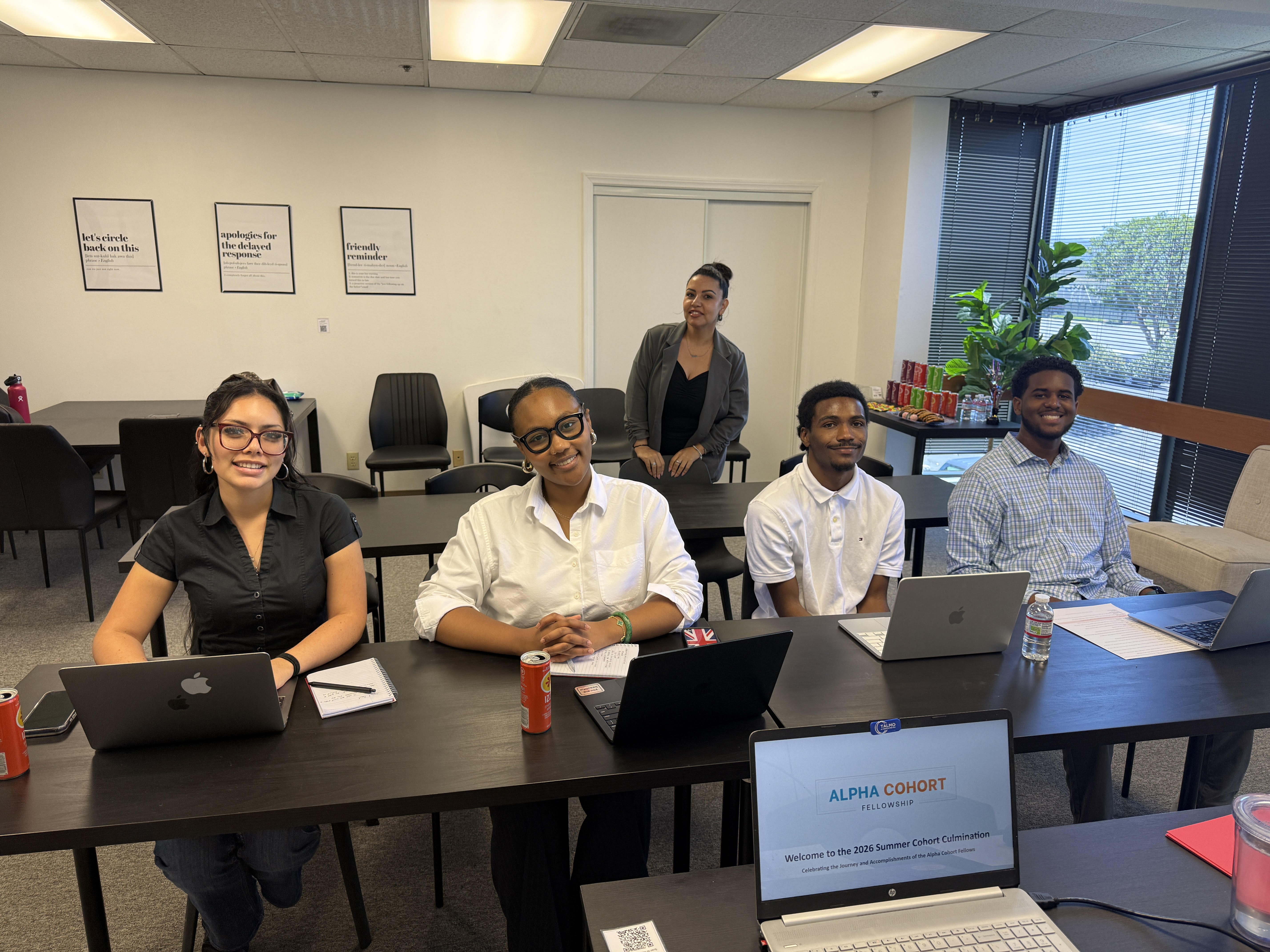
This summer, Alpha Cohort Fellowship gave college students an opportunity to experience that transition firsthand.
Through paid internships, professional development workshops, mentorship, and exposure to real workplaces, our Summer Fellows were able to move beyond learning about the professional world and begin learning inside it.
Career readiness is about more than having a degree.
Employers want candidates who can communicate, collaborate, solve problems, adapt to new situations, and apply what they know in a professional environment. Those skills are difficult to develop through coursework alone.
Internships create an important bridge between education and employment.
Current data reinforces their value. According to the National Association of Colleges and Employers, students who completed paid internships were more successful in the job market. Among members of the Class of 2026 who had paid internship experience and applied for jobs, 55% received at least one job offer.
For students, that real-world experience can provide something equally important: evidence that they are capable.
There is a difference between saying, "I think I could do this," and being able to say:
"I have done this."
That distinction matters when a student enters an interview, writes a resume, speaks with a recruiter, or begins their first full-time job.
Alpha Cohort Fellowship was built around the idea that emerging professionals need opportunities to put their knowledge into practice.
The program connects college students with businesses where Fellows can gain hands-on experience while continuing to develop the professional skills that help them succeed in the workplace.
ACF's public program model emphasizes paid internship opportunities, mentorship, professional development, and work on meaningful business projects.
During the Summer Cohort, Fellows gained exposure to areas including business operations, marketing, finance, technology, project coordination, research, and professional communication.
But some of the most valuable lessons were not tied to a specific job title.
They came from learning how to:
These are the experiences that help turn classroom knowledge into career readiness.
Confidence is sometimes treated as a personality trait. In the workplace, it is often the result of experience.
The first professional email can feel intimidating.
So can the first meeting.
The first presentation.
The first time someone asks for your opinion.
The first mistake you have to correct.
But each experience gives a student another reference point.
Over time, unfamiliar situations become familiar ones.
Research on career development has similarly connected applied learning experiences with stronger career-related self-efficacy, including greater confidence in articulating skills, preparing for interviews, and planning for future careers.
That is one reason meaningful internship experiences matter.
They give students a place to practice being professionals before they are expected to arrive in the workforce already knowing how.
Experience alone is valuable.
Experience combined with guidance can be transformative.
A supervisor or mentor can help a student understand not only what to do, but why it matters.
Why was one presentation more effective than another?
How should you handle a difficult conversation?
What does professional communication actually sound like?
How do you advocate for an idea while remaining open to feedback?
How do you recover when something does not go as planned?
These lessons are rarely learned from a textbook.
They develop through conversations, observation, feedback, repetition, and reflection.
That is why mentorship and professional development are important components of the Alpha Cohort experience.
One of the most important outcomes of an internship is that students leave with stories they can tell.
Instead of telling a future employer:
"I am a good communicator."
A Fellow can describe a presentation they delivered.
Instead of:
"I work well on a team."
They can explain how they collaborated on a project.
Instead of:
"I am interested in marketing."
They can talk about content they helped create, research they conducted, or a campaign they supported.
Those examples become evidence.
They strengthen resumes, LinkedIn profiles, interviews, portfolios, and professional conversations because they show what a student has actually experienced and contributed.
Internships are not only valuable for students.
Businesses benefit when emerging professionals bring curiosity, fresh perspectives, developing skills, and new ideas into an organization.
National internship data shows that employers continue to invest in early talent. NACE reports that 81% of participating employers planned to either increase or maintain intern hiring for the 2025-26 cycle.
For organizations willing to create meaningful opportunities, hosting an intern can become part of a broader strategy for talent development, mentorship, community engagement, and future workforce planning.
It also gives experienced professionals something valuable: an opportunity to help shape the next generation entering their industries.
The Summer Cohort was about more than completing an internship.
It was about building confidence through experience.
It was about asking questions.
Trying something unfamiliar.
Learning how workplaces operate.
Meeting professionals.
Receiving feedback.
Discovering strengths.
And beginning to see a clearer path forward.
That is the kind of growth that may not always fit neatly into a resume bullet point, but it can influence every professional opportunity that follows.
At Alpha Cohort Fellowship, we believe emerging professionals deserve more than advice about preparing for the workforce.
They deserve the opportunity to experience it.
Businesses and organizations can play a meaningful role in that journey.
Alpha Cohort Fellowship partners with organizations that want to provide college students with paid, real-world internship experience while helping build the next generation of professionals.
Interested in becoming a Host Partner for an upcoming Alpha Cohort?
Learn more about partnering with Alpha Cohort Fellowship and how your organization can help create meaningful career opportunities for college students at alphacohort.com.